Financial reality often hits hard at the beginning of the year. Holiday spending shows up on statements and savings may be lower than usual, but everyday expenses keep coming. For community banks and credit unions, this raises a critical question: “When account holders need short-term liquidity, will they turn to us?”
When fair, well-communicated options like overdraft protection or small-dollar loans aren’t available, people don’t stop needing help. They’ll look elsewhere. When bills are due, speed often trumps cost. Account holders may choose options that are easier to access, even if those options are more expensive, riskier and harder to recover from.
Below are five common alternatives to turn to when short-term cash isn’t readily available, and the risks that come with each.
Option 1: Payday Loans and Short-Term Lenders
Payday loans are often one of the fastest ways to get cash. But with average APRs nearing 400%, they’re among the most expensive options, one that can trap consumers in a cycle of debt.
Most payday loans are due in two to four weeks. If borrowers can’t repay the full amount, loans are rolled over and additional fees are added. What starts as a few hundred dollars can snowball into months of repayment.
In recent years, the Consumer Financial Protection Bureau (CFPB) has cracked down on payday lending practices. However, a 2025 statement from the Bureau advised that payday lending enforcement wouldn’t be a priority. With reduced oversight, consumers who turn to payday lenders face greater long-term financial risk.
 What starts small can grow quickly. Payday loans often lead to mounting fees and extended repayment cycles.
Option 2: Pawn Shops
Pawn shops are another way to make ends meet, but often at a steep cost.
In a typical pawn transaction, a customer brings in an item of value (e.g., jewelry, electronics or tools) as collateral and receives a short-term cash loan, often for just 40%–70% of the item’s resale value. The pawnbroker holds the item while charging monthly interest ranging from 2% to 25%. If the loan isn’t repaid within the set term, the item is forfeited and sold.
Because pawn loans don’t affect credit score, some borrowers view them as lower risk. But the downside is permanent: if the loan isn’t repaid, the property is lost entirely. Losing essential items can create long-term financial hardships, while losing sentimental items can be emotionally devastating.
An analysis by The Hustle showed how unpredictable pawn shop pricing and interest rates can be. Studying 38,000 transactions on an online pawn platform, a researcher found the average difference between the highest and lowest loan offers was about 80%. For a consumer pressed for cash, that variability can easily result in an unfair deal.
Option 3: Borrowing from Family or Friends
When faced with a bill they can’t pay, research shows that consumers are most likely to borrow from family or friends, or not pay the bill at all. While asking for help from family or friends can feel like a safe option, it carries its own risks.
Loans between family members are often verbal and informal, without defined repayment schedules. As a result, relationships can become strained if repayment takes too long or the borrower doesn’t use the money in ways their loved one deems appropriate. It can also create unhealthy power imbalances or put financial pressure on loved ones. Additional drawbacks include limited legal protections, reputational damage and no opportunity to build credit.
In short, money changes relationships. For many borrowers, the emotional cost can be higher than any interest rate.
Option 4: Skipping or Delaying Payments
Another common response to cash shortfalls is skipping bills altogether.
A key indicator of a person’s financial situation is whether they can pay their bills regularly. The Federal Reserve’s research on the economic well-being of U.S. households in 2024 found that 17% of adults didn’t pay all their bills in full in the month prior to taking the survey.
Skipping bill payments (or making partial payments) may seem like an easy solution, but the consequences can add up fast. Late fees, penalties, interruptions in service, credit score damage and collection agents can all follow, making it harder to recover financially.
Option 5: Charging Credit Card(s)
Using a credit card or balance transfer to cover an immediate expense can feel like a smart solution. But if balances aren’t paid off quickly, they often lead to deeper debt.
The average credit card APR now exceeds 22% and the average U.S. household carries more than $9,000 in credit card debt. At those rates, even small balances can become expensive fast. The longer a balance goes unpaid, the harder it is to make progress toward paying it down.
Balance transfers can also create a false sense of progress. While promotional lower interest rates may offer temporary relief, transfer fees, new purchases and missed payoff deadlines can cause balances to balloon. Over time, this snowball effect can damage credit scores and limit future borrowing options.
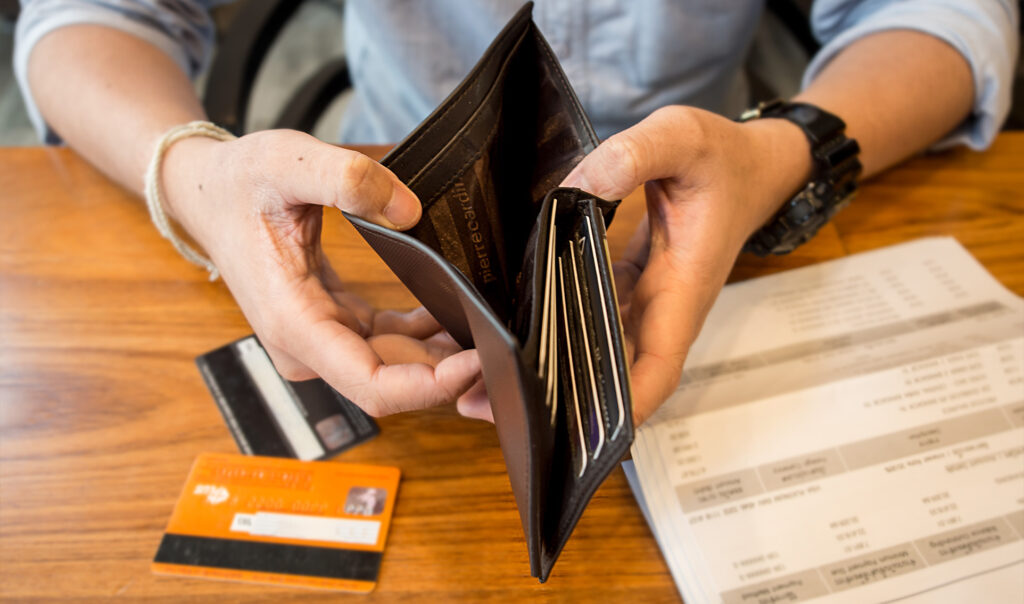 Credit cards can fill the gap—and create one. High-interest credit card debt can limit future options and strain household finances.
Why Speed Wins When Money Is Tight
If these options are all so risky in one way or another, why do people still use them?
Part of the answer lies in how people respond to scarcity. When money is tight, attention focuses on the most urgent need, leaving less mental bandwidth to weigh long-term costs or risks. In these situations, people aren’t comparison shopping. They’re just trying to get through the moment, so fast access often wins out over affordability.
The Role Financial Institutions Play
Financial pressure on consumers remains widespread in 2026. Last year, nearly one-quarter of U.S. households lived paycheck to paycheck. Financial anxiety affects 77% of adults, and more than one-third say money stress has impacted their mental health.
The stress is especially pronounced among Gen X, a significant segment for community financial institutions. Despite being in their peak earning years, nearly half support their children and their aging parents. Four out of 10 lack three months of savings, and they carry the highest average credit card debt of any generation.
Community banks and credit unions position themselves as trusted partners, with the promise of being there for account holders. That promise is put to the test during moments of financial stress.
Unlike payday loans or pawn shops, liquidity solutions from banks or credit unions have clearer terms, more predictable repayment and lower costs. Going through a financial institution also offers the peace of mind of working with a trusted, regulated institution.
Fair and responsible overdraft protection and small-dollar loans can provide a safer alternative, especially when borrowing limits are tied to an account holder’s ability to repay. Instead of a one-size-fits-all amount, dynamic limits based on account activity and transaction history are used. This helps consumers avoid taking on more debt than they can handle.
Use of these tools is also visible to the bank or credit union, allowing the financial institution to reach out to an account holder when usage patterns indicate stress, offering financial education, guidance or additional support.
Access to short-term cash gives consumers a safer way to manage temporary financial challenges while protecting their credit and long-term financial health, while strengthening their long-term trust and loyalty to your institution.
One of the most common (and most misunderstood) ways consumers access short-term cash is overdraft. Take a deeper look at how overdraft programs can evolve to provide fair, transparent access while reducing reliance on riskier alternatives in our white paper, Overdraft Isn’t Over.
Read the white paper
Tim Barrett, Executive DDA Strategist and Product Owner of Intelligent Limit System®
Tim Barrett is Executive DDA Strategist and Product Owner of Intelligent Limit System® (ILS) at CSI. With more than 30 years of experience in banking technology, data analytics and consumer liquidity strategies, he is a trusted advisor to hundreds of financial institutions of all sizes. His leadership focuses on delivering optimized account holder experiences through revenue-driving, compliance-focused software solutions. As Product Owner of Intelligent Limit System®, he leads enhancements to the Consumer Liquidity Engine™, integrating advanced data analytics with regulatory expertise.